Tuesday, December 30, 2014

Publishing is like a trip across the desert

When I was twelve, my family took a road trip from New Jersey to San Francisco and back. One of the most astonishing sights was the Great Salt Flats - a desert of salt, even flatter than my home South Plains, as far as the eye could see in every direction. Well into the flats, we spotted something peculiar beside the road ahead. We couldn't yet make out what it could possibly be, so I read for about ten minutes and then looked up for it again, sure it would be close now. It was still too far away to figure out even what its shape was. So I read for another ten minutes or so, looked up and found it was, though noticeably bigger, still quite far away. I bet it was nearly an hour from the time we first noticed it to when we passed it and could see it was a huge cactus-shaped sculpture with sports images (soccer ball, bowling pins, etc.) attached.

I think back to that astonishment at just how long it took to reach the sculpture, the impossibility of telling the distance due to the monotony of the salt flats, when I'm publishing something. When we've finished the writing and basic editing phases, it feels as if I'm almost done. Yet then once I put all the chapters into a master document and start reading it for final fixes, well, they just keep coming. I'll find a screen capture of code that doesn't follow our conventions, so I have to go back, find all the files with the error, fix them, make the screen captures, crop them, open each chapter, and reinsert the pictures. Then I'll find a chapter where we didn't include the exercise answers, and then in making the answers realize that it requires a step we never taught them, and references things we haven't indexed ... No matter how much time I try to allow for this phase, it always takes three times as long as I thought.

But, like that crazy road trip, I actually really enjoy publishing. I love books and learning so much it's a joy to get books ready to teach African students comprehension-based learning that also challenges them spiritually. That's been my favorite part so far, writing the "Eternal Thoughts," discipleship topics at the end of this chapter. They're nice little lessons in themselves, but their real power comes in the way they open the door for the teachers to engage the students, wherever they are in their spiritual journeys and "Lead them the the very Truth, to the Master Himself from whom alone they can learn anything" (George MacDonald). (See my Eternal Thoughts post for an example.)

Both the desert analogy and the discipleship I'm working on remind me of a passage I studied recently, Isaiah 40:3-5:

A voice cries:
“In the wilderness prepare the way of the LORD;
make straight in the desert a highway for our God.
Every valley shall be lifted up,
and every mountain and hill be made low;
the uneven ground shall become level,
and the rough places a plain.
And the glory of the LORD shall be revealed,
and all flesh shall see it together,
for the mouth of the LORD has spoken.” (ESV)

May we in our own hearts prepare the way of the Lord, raising up the pain and hopelessness, leveling down the pride, and praying for the glory of the Lord to be revealed in us.

Tuesday, November 25, 2014

Remember our siblings who suffer

I'd like to take this week to ask for prayer for a partner. Rev. Samuel Kargbo is a pastor in Sierra Leone who contacted us about starting a computer school to minister to the youth in his village. It's a dream fit, because our program is designed just to help a community like his start a small but effective school affordably and grow. However, soon after he started correspondence with Ray, our New Ministries Coordinator, ebola hit his village. They have been weeks in basically quarantine, trying desperately to contain the ravaging disease. He recently wrote Ray,

Your mails always give me joy and hope that my family has a host of brethren praying for us, especially during this horrible time of Ebola Virus epidemic.

We are employing your indulgence to remember the Ebola virus victims in your daily prayers. Some homes guaranteed are not properly taken care of. No adequate provision of food items and not even a proper security. A lot of them go out with in search of food, thereby passing the virus with those that they come in contact with in the public transport buses, in the market ...€ because they are not secured and no adequate food provided.

We have some kids that have become orphans as their parents have died from the Ebola virus disease. We also have some widows and widowers. The ebola virus has actually caused a lot of trouble among our people. Our small congregation lost five people, one man, two women and two kids.

Sam and his family have been experiencing illnesses which they cannot get treated because everything is being poured into stopping ebola. Please pray for our brothers and sisters in Sierra Leone, Guinea, and Liberia as they continue to suffer and strive for life. May the Lord rescue them from the hand of the evil one who attacks them with this disease, and then I pray for an opportunity to give them a chance for something better, power to implement long-term improvements in every facet of life, with TEN3 education.

Tuesday, November 18, 2014

Thank You, Thank You, Thank You

I would normally consider it most germane (I love that word) to wait until next week to put a "Thankful" post, but today I've been so reminded of my blessings that I'm overflowing. I am truly awestruck at just how good God continues to be to me. First, of course, there's that whole salvation bit – loving me enough to come to this miserable world where I am, to suffer and die to bring me life, to restore me from the fear and pride that enslaved me, to bring me into His wonderful life of love. That's enough to sing of forever. And yet He keeps making it more wonderful. He brings along my way so many precious people who give me sparks of His grace. He's given me the opportunity to learn—to read and think and understand things like the story arc, programming logic, stoichiometry, periodic motion, contentment, pedagogical principles, the effects of media on the family, and write about them. Then on top of that He's given me such an amazing opportunity to use the fantastic gifts and talents He's given me to be part of His Kingdom spreading among the rich, beautiful hearts of Africa. And as if that weren't more than enough, then He brought into my life one of His sons who humbles and challenges me with his devotion to the Lord, and who blows me away with how much he loves me.

How can it be that amid all this I sometimes still find myself sinking into doubts that tempt me to grumble? And how can it be that in those times, He sends me yet another reminder that His grace is unlimited ... like the couple who told me today they want to join my support team, though they're probably struggling with their finances even more than I am. Blown away again.

What can I do in the face of all this lovingkindness? Nothing but fall to my knees whispering, "God is so good. God is so good. So very good."

Tuesday, November 11, 2014

Church planting with computer schools

"That's not missions."

I've heard that more than a couple of times when I've described what I do or what I'm going to Africa for. Missions is coming into some grass hut village to play with kids, hand out clothes, and give a revival-style service so they all raise their hands to accept Jesus. At least that's what people seem to have in mind a real missionary does.

There are quite a few problems with this idea. While there ARE some great valid ways to do short-term missions, to do what I just described would be disastrous. Most people who have never heard the gospel don't speak English well, if at all. And wouldn't you be highly suspicious, probably even hostile, if a strange-looking group of people with loud equipment showed up in your neighborhood asking to talk to your children and telling you to convert to a strange religion?

Of course you would. Anyone would. "But that's how Paul did it," some might object. Yes, he did travel a lot of places and sometimes plant churches fairly quickly. But he had a lot of advantages going for him. Everywhere he went, people spoke Greek, a language he was already fluent in. Even though he was the apostle to the Gentiles, you'll notice he almost always started by preaching at Jewish synagogues, to people who already believed in the God of Abraham and knew the Scriptures. So it was a fairly simple matter to introduce Jesus as the Messiah they were waiting for. Then, when he did preach directly to Gentiles, it's evident that he was well-read in their poetry, philosophy, and history, because he used those in preaching to them. He knew their culture well enough to start where they were at, and when they did convert, they joined churches that had Jewish believers there who could teach them the Scriptures. There was a discipleship structure already in place.

With that background, I can explain how really our model is closer to Paul's than you might at first think. We, too, take advantage of our language being prevalent in Africa. We train people who are fluent in English, but encourage them then to teach classes in the local language when that will serve better. That way, we can reach potentially hundreds of villages speaking hundreds of different languages without our little team having to take the time to learn them all, which would be impossible. We also work with people who already follow God, equipping them to disciple new believers, in their own communities and in new territories.

But our starting point, rather than the synagogues or acropolis like Paul used, is with a felt need in Africa--education. Education allows missionaries to build relationships, and relationships are what missions is all about. As people learn to trust their teacher, they learn to trust the One in whom their teacher trusts. The teacher can learn the worldview and deepest needs of the students, and learn how from there to show them that Christ is the Way, the Truth, and the Life, who can transform every aspect of their lives.

Therefore, we're praying now for missionaries to be able to take our Computer Training Outreach and use it for church planting. Say a Nigerian takes our CTO at a center in his village and gets excited about the gospel. Say he hears that churches need to be planted in a village in Rwanda. With 24 laptops, he could go start a computer school in that village, a self-sustaining center for teaching the Bible as the story of redemption. He's leading people to Christ and giving them the foundation for a biblical worldview. He could train both church leaders (hopefully having them sent to places with more advanced training, too) and people to run the school, and after a few years move on to a new village ... perhaps taking a few Rwandians along to learn how to do the same thing in new places.

Multiplying, sustaining discipleship. If that's not missions, what is? Please pray for the places that want to start these computer schools already (we're hoping soon to put specific school profiles on www.ten3.org), that they get them running and running well. Also pray for the students who will go through them, that they may become godly power users of technology, and Christian leaders, wherever God leads them, be it staying at home serving their communities or going to new lands to make disciples themselves.

Monday, November 3, 2014

Eternal thoughts

As we write computer courses, we consider how best to incorporate discipleship points for the students that the teachers can use. Sometimes it's exercises that require them to read and think about a Bible passage while applying a computer skill. For instance, in Computer Essentials, they practice their word processing skills on a document of Ecclesiastes. One thing they have to do is compose headings for the whole book. Other times, we just incorporate "Eternal Thoughts," tying some principle they had to practice on the computer to life in the perspective of eternity. Here's an example:

Eternal Thoughts, Programming & Databases 1, chapter 6, "Decisions"

Computers only make the decisions we tell them to. We have to tell them the conditions ahead of time. If this is true, do this, if not, do that. Human beings are much more complex in the way we make decisions. We'd like to think that we make all our decisions rationally, doing what makes the most sense and what we know is right. But emotions are also very powerful in our decision-making. Advertisers and propagandists know this, and make sure to send you the message that the decision they want you to make, whether to buy a certain product or support a particular politician, will lead to good feelings. They also try to make you feel bad if you don't make that decision. People's "gut reaction" also sometimes guides their decisions – a sense they can't explain that something is the right or wrong decision. Psychologists usually attribute this to perceptions we haven't consciously processed, memories we haven't consciously associated with the situation at hand, etc. Spirituality also influences our decisions – Satan will throw anything that he knows affects your decisions, whether it's reasons or fears or lusts or dreams, to try to tempt you. On the other hand, people who have walked with Jesus a long time develop a sensitivity to the Holy Spirit so that they begin to sense what is right even when they don't have enough information to base their decision on logic.

All these influences factor into our decisions, in a way that even we don't fully understand. We sometimes don't know why do the things we do. How then can we hope to make the right decisions? We certainly cannot just idly hope that whatever we decide will be right. We are far too prone to sin for that. The old saying that "Those who fail to plan, plan to fail" is true when it comes to sin. That's especially true for the sins that Jesus addresses in the sermon on the Mount about anger, retaliation, sexual sin, and worry. Those are sins that we commit when our emotions overtake us – we are usually not even capable of reasoning logically in the situations when we are tempted to these things. That's why it is very valuable to "program" ourselves ahead of time, that "if this happens, then I will do thus, no matter how I feel." If the decision is already made when we are capable of thinking, we can stand firm in it even when our feelings pressure us to sin.

Thinking these things through and deciding beforehand to do what is right can save us from a world of hurt. But we can't anticipate every temptation. That's why it is so important to be growing and walking daily in the Lord, seeking him in prayer and the Scriptures, disciplining ourselves to obey him in the small things, so that we are made to be more like him. As we do that, gradually our "first instinct" instead of selfishness will become to honour Christ.

Consider the following passages and how you are applying them in your life:

I want you to know, brothers, that our fathers were all under the cloud, and all passed through the sea, 2 and all were baptized into Moses in the cloud and in the sea, 3 and all ate the same spiritual food, 4 and all drank the same spiritual drink. For they drank from the spiritual Rock that followed them, and the Rock was Christ. 5 Nevertheless, with most of them God was not pleased, for they were overthrown in the wilderness. 6 Now these things took place as examples for us, that we might not desire evil as they did. 7 Do not be idolaters as some of them were; as it is written, "The people sat down to eat and drink and rose up to play." 8 We must not indulge in sexual immorality as some of them did, and twenty-three thousand fell in a single day. 9 We must not put Christ to the test, as some of them did and were destroyed by serpents, 10 nor grumble, as some of them did and were destroyed by the Destroyer. 11 Now these things happened to them as an example, but they were written down for our instruction, on whom the end of the ages has come. 12 Therefore let anyone who thinks that he stands take heed lest he fall. 13 No temptation has overtaken you that is not common to man. God is faithful, and he will not let you be tempted beyond your ability, but with the temptation he will also provide the way of escape, that you may be able to endure it.

1 Corinthians 10, ESV

10 Finally, be strong in the Lord and in the strength of his might. 11 Put on the whole armor of God, that you may be able to stand against the schemes of the devil. 12 For we do not wrestle against flesh and blood, but against the rulers, against the authorities, against the cosmic powers over this present darkness, against the spiritual forces of evil in the heavenly places. 13 Therefore take up the whole armor of God, that you may be able to withstand in the evil day, and having done all, to stand firm. 14 Stand therefore, having fastened on the belt of truth, and having put on the breastplate of righteousness, 15 and, as shoes for your feet, having put on the readiness given by the gospel of peace. 16 In all circumstances take up the shield of faith, with which you can extinguish all the flaming darts of the evil one; 17 and take the helmet of salvation, and the sword of the Spirit, which is the word of God, 18 praying at all times in the Spirit, with all prayer and supplication. To that end keep alert with all perseverance, making supplication for all the saints

Ephesians 6, ESV

Monday, October 6, 2014

Confession

Kenneth and I are studying through the book of Matthew together, and last night we finished up the Sermon on the Mount. That is one of the hardest passages in all of Scripture! As we exegeted it, this passage cut me to the heart:

“Not everyone who says to me, ‘Lord, Lord,’ will enter the kingdom of heaven, but the one who does the will of my Father who is in heaven. On that day many will say to me, ‘Lord, Lord, did we not prophesy in your name, and cast out demons in your name, and do many mighty works in your name?’ And then will I declare to them, ‘I never knew you; depart from me, you workers of lawlessness.’" (7:21-23).

These are not heathens. They're not backsliders. They are heroes of Christian ministry! They confess Jesus as Lord. They did all kinds of great Kingdom work. Yet they didn't do the Father's will. They did all these great things for God, even with God's power, it seems, yet without really knowing or being known by Him. And it pierced me because I have such a repeating history of pressing on with my great works, but really just wanting my own acclaim, my grand agenda. Or thinking I know best. Or have to be the best. I worshiped perfection for far too many years, and saw last night that I still retain so much of the pride that drove me to it, driving me still in the areas where I act as if it's too much to humble myself and listen, to put others above myself.

And so I must revert to the prayer, ruefully given too many times and not enough, for my gracious Father to forgive me, to teach me to love as He loves, to do no more my will but His.

Staff retreat 2014

I've finally got the pictures from the staff retreat, so without further ado, here's the lowdown of our conference: We came from all over; Ray from California, me from Texas, Ken from Minnesota, several from the northeast, Christie from Nigeria, and Gilbert from Zambia (sort of; he had been traveling all over North America!) We gathered in lovely Charlotte, NC. We opened each morning and afternoon session in prayer and worship, for if we are not seeking the Lord, what is the point of anything we're doing?

One of our major topics was getting the CTO implemented. It's not a lot of good to work so hard making a great product (which we have) if nobody's using it! So we discussed with Christie, Gilbert, and Ray how we can best help 7 centers in Nigeria, 3 in Zambia, one in Sierre Leone, and one in Kenya start running the CTO to reach their young people for Christ, teaching them the gospel while they learn godly use of technology.

We also brainstormed ways to help more schools run the CTO:

Some of these suggestions were just funny ones when it was somebody's turn who couldn't think of a new one ... and we needed a few laughs to keep up our energy! The one on the upper-left hearkens back to my previous post. ;)

Another major topic was a registrar model to enable Africans to make educational accountability of the CTO into a sustainable business, and support each other in forming and maintaining standards. By this time, we were getting pretty tired, as you probably are too by the thought of this much detailed discussion:

But we still had do discuss the direction my department, the curriculum department, is taking. We have two main thrusts of development now. The simple one is materials to teach a broader audience like African families and pastors about technology, with its uses and dangers. The more involved one one is more advanced computer training that will help schools run more sustainably, give graduates more opportunities to serve needed technology fields, and give teachers the training and tools to start developing, their own Christ-centered transformational curriculum. As we come alongside to help them develop it, we will also make it available across Africa so that the teachers' hard work can make an impact everywhere.

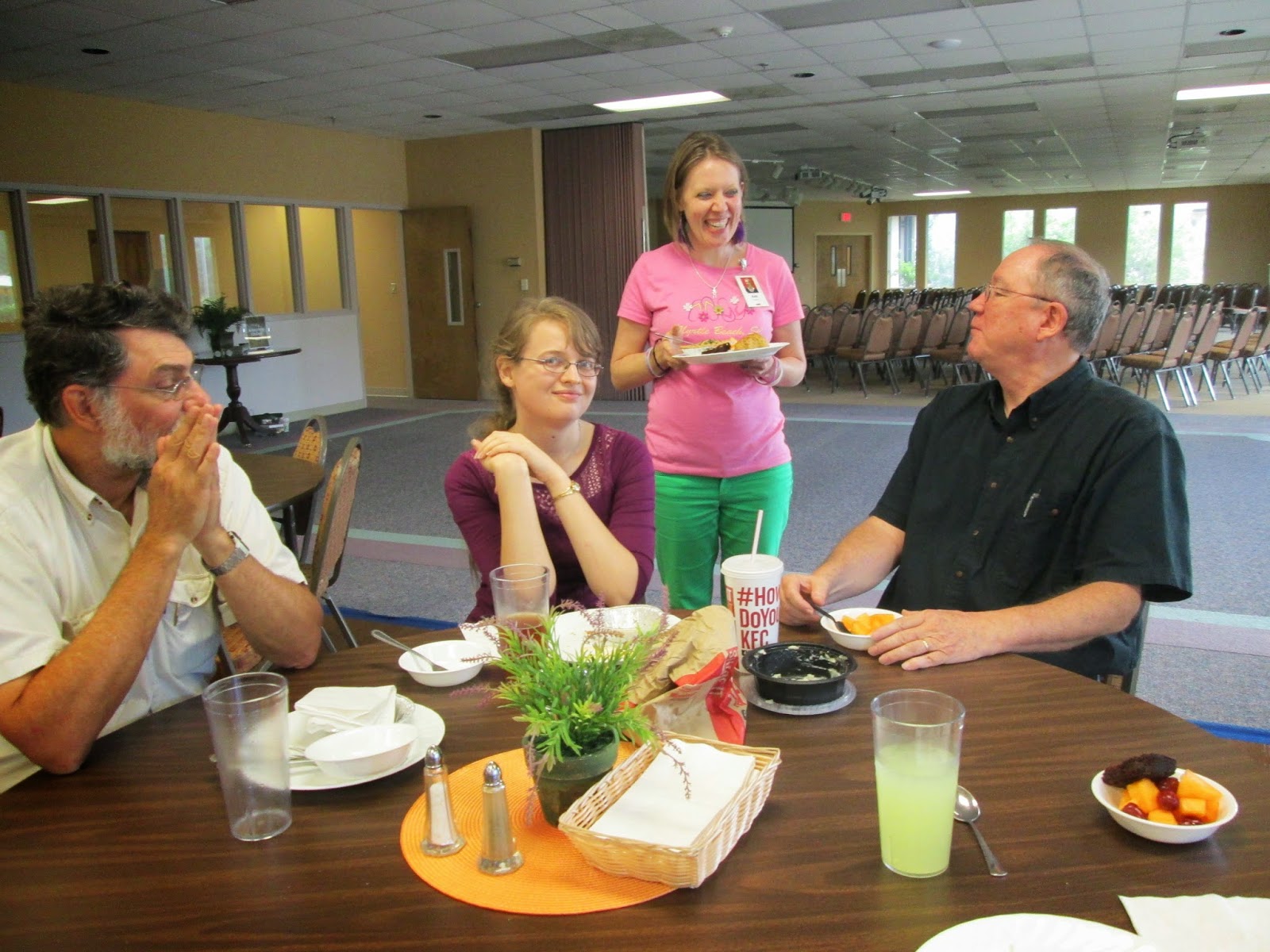
And of course, it's always great just to fellowship with the team. Since we met at SIM-USA headquarters.

We also got to connect with some of the wonderful SIM home staff:

I hope you enjoyed that little taste of Charlotte and the blessing it was to get to strategize with the team. A few things you can be praying for in light of what took place:

  • The 7 centers in Nigeria that want to offer the CTO. Pray that the business plan we started to draw up will solidify as Christie gets more data, and that there will be no obstacles to them opening and teaching the gospel through computer training.
  • The centers in Zambia that are interested in offering the CTO, that they will get the right personnel dedicated to championing and teaching it.
  • The possibility of other missionaries using our CTO as integrated church planting in new locations.